November first was a landmark day for this blog. But before I get ahead of myself, let’s back up for a sec to establish two facts that you need to know:
1. A cheese skipper is a fly larva that is used to ferment casu marzu cheese. It apparently has the ability to launch itself a distance of several inches, which may not seem like much, but really kind of is when you are smaller than a half-inch. I have never encountered either a cheese skipper or a casu marzu, so I’m just going off what the internet tells me here.
2. The impetus behind this blog (in its previous incarnation) was so family and friends could keep track of me during four-and-a-half months of travel back in 2007. I must have recently learned about cheese skippers, and in trying to come up with the name of a travel blog, it wasn’t a big leap, no pun intended, from cheese skipper to cheese skipping. Since I like cheese, and the word “skipping” is evocative of motion that is buoyant and not necessarily in a straight line, it seemed like a dandy name for a blog, even if it is a secret reference to maggots.
I still eat a lot of cheese, both at home and on the road, but since most of it is of the more standard variety, it’s not worth writing about. However…
At some point last month during German class, my teacher mentioned a cheese made in Switzerland and processed in some manner by baby spiders. Something like they eat the cheese and create little holes. I can’t quite remember how this nugget of info came about; it may have stemmed from a conversation about Leberkäse, a baloney-ish concoction in loaf form that is a very popular fast food with Austrians. It’s frequently served on a little plate with a dollop of mustard and a semmel roll, or in the roll in sandwich form. Despite its name, it contains neither liver nor cheese. I ate it once and decided I never need to do that again. It wasn’t awful, it was just completely unremarkable. Anyway, searching the internet didn’t turn up any Swiss spider cheese, but it did turn up Milbenkäse, a cheese processed with the help of hungry cheese mites (Milben is German for mites), in Würchwitz, Germany. Würchwitz is a bit south of Leipzig, and coincidentally, Leipzig was on my itinerary for this trip. Coincidence upon coincidence! It seemed unthinkable to visit Leipzig, and not make the effort to go out of my way just a bit to seek out the cheese mites of Würchwitz.
According to the literature I picked up, this is how Milbenkäse is made: take low-fat quark, season it, form it into a pat or lozenge, and bury it in a box that contains a whole lot of mites and a teeny bit of cereal or flour of some sort. The mites eat the cereal and cheese, and their digestive process, to put it politely, preserves and flavors the cheese. Maintain the health of the mites daily, feeding them more cereal (or else they’ll eat all of the cheese), keep a constant temperature and humidity, and three months later, voilá, Milbenkäse. At this stage, it’ll apparently just last forever. We were shown a bowl of cheeses over 100 years old and as hard as rocks. They would need to be grated for consumption. This is a very old process that was nearly lost last century. Modern refrigeration has obviously eliminated the need to produce preserved food, and now the production of Milbenkäse is simultaneously part of the slow and artisan food culture, and a preservation of heritage and tradition. And apparently it attracts quite a lot of tourists.
I really had no clue what to expect on this adventure. I knew there exists a statue of a cheese mite in Würchwitz, but I wasn’t sure where. Two friends in Leipzig decided to accompany me, and I was slightly worried the entire endeavor was going to end in disappointment. But it all turned out better than I could have imagined. First of all, it is impossible to miss the cheese mite statue, in all its marble glory, carved by local masons, when you drive into Würchwitz.
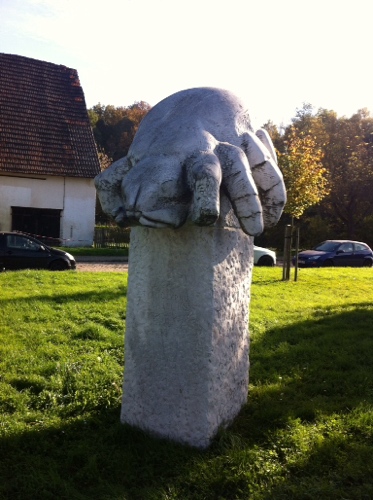
it’s a giant marble cheese mite
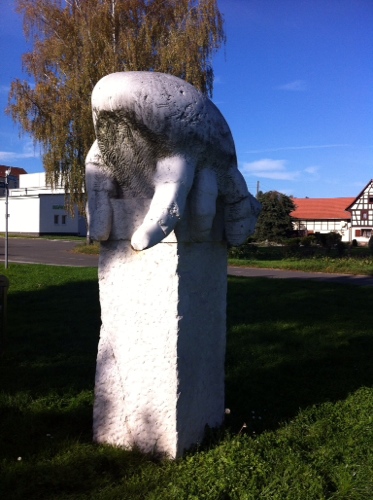
…and from behind
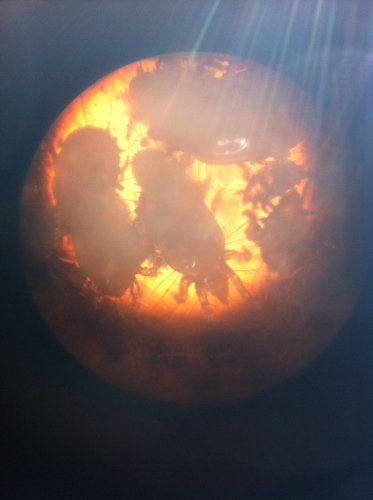
Second of all, we met the Milbenkäsemann himself, Helmut, the one guy in town who makes this cheese and runs the very tiny museum in his home, who just happened to be standing in his yard and took a shine to us. I think it’s because we were a small group who showed up in a car instead a tour group in a bus, and were possibly displaying a bit of childlike giddiness simply at being in Würchwitz. We got the full tour and lengthy explanation, which included sticking our fingers into a box full of mites and cheeses, viewing mites under a microscope, and slices of cheese, mites and all. And we all walked off with a small cheese, wrapped in foil, dusted with approximately 100,000 mites. Helmut told us to make sure we washed our hands thoroughly, or else the mites would start eating our fingernails (the ones that were still hanging out in our mouths were apparently busy cleaning our teeth). I’m very happy that my friends came along; it was an educational and highly amusing adventure for all, and having charming translators earned us some extra time and attention.
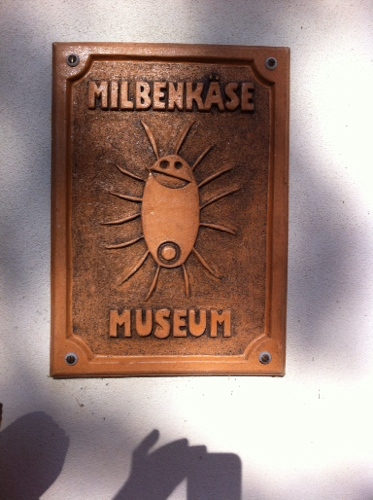
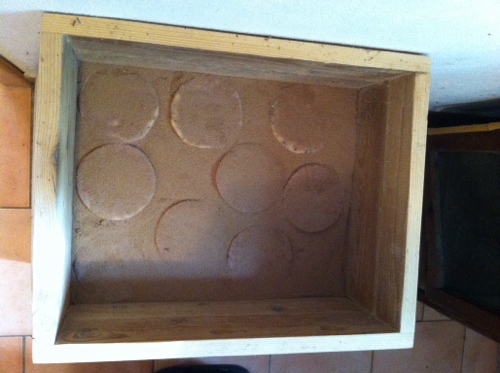
So it was a weird and wonderful day. Not only did I unintentionally realize the jokey origins of this blog’s name (if not exactly, pretty darn close), but it embodied my fundamental principles of travel. Be curious and seek out curiosities. Discover unique things. Discover local traditions and culture. Be open to happenstance and spontaneity. Make personal connections. Don’t be afraid to eat something that has bugs on it. Learn something new and unexpected. Have fun and a laugh while doing it. And share the experience with others.

 Cheese Skipping
Recent Comments