Traveling involves constantly dealing with three key logistics: where to stay, how to get there, what to eat.
Eating healthy on the road can be challenging for any number of reasons. I try to maintain some sort of teetering balance by eating fresh fruits and veggies when I can, but even that’s a challenge, also for a number of reasons. One is that fruits and veggies don’t always travel well, especially for those packing light, and more times that I care to admit, I’ve trashed fruit because it got squished in my bag, or became otherwise unpalatable. It happened again last week. Two apples and two oranges found their way to the bottom of my bag, and became a juicy, sticky mess, fortunately contained in a plastic bag. I resolved to stick by a new travel rule: I will never again buy fruit that I can’t consume immediately. It’s just not worth the hassle and waste, both food-wise and money-wise. I gave the two smashed oranges to a monkey. I know I shouldn’t have, but throwing them in the trash wasn’t the right solution, either. I clearly wasn’t the first handout to come along; the first crinkle of the plastic bag had her walking up to me directly. I set down the oranges and backed off. The monkey seemed quite pleased with her treats, sticky or otherwise. She ate one while holding onto the other with her feet; safekeeping, I guess, in case any other monkey ambled by.
Fortunately, Southeast Asia has alternatives in the form of a bag of chopped fruit from a vendor (with a separate little bag of chili salt), but even that was unsatisfactory. Maybe I just got a bag of crappy, unripe fruit, but most of the fruit that I’ve purchased here hasn’t been very good. The best option I’ve found are fruit shakes (fruit, condensed milk, more sugar, ice). I decided that shakes are an acceptable and convenient alternative to my quest for vitamins. And arguably cheaper, as I have both suspicions, and at least one confirmation, that I’m being overcharged for fresh fruit sold by the kilo.

I have no clue what most of these fruits are
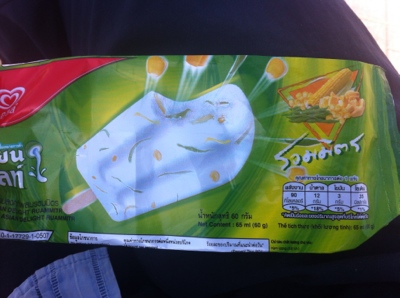
Also available in ice cream bar form. Corn, jackfruit, and something green.
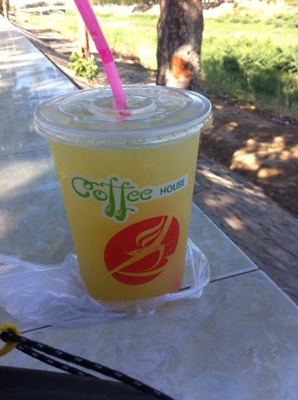
Fresh sugar cane juice. This purchase was a 62¢ score. The base of this cup is at least three inches in diameter.
I’ve been keeping an eye out for insect snacks (protein, you know), and finally found some at the night market by the river in Battambang. A lady had three trays set up – peanuts, slices of fruit with chili salt, and a pile of fried crickets. I walked around for a couple of blocks while trying to screw up the resolve to go back and buy a bag. I finally made my way back, took some photos, ate a sample, which is easy when everyone is watching, and splurged one dollar on a bag. I guess the bags only come in one size, or else my sign language indicating that I wished a smaller bag failed. Realistically, I wanted something in the neighborhood of, say, five crickets. The scoop was a tin can, sort of canned vegetables–sized, which was filled to overflowing and dumped in a plastic bag. Wanting to take a photo, I headed back to my hotel, where, not surprisingly, my bag of snacks started looking far less appetizing than they did on the street. I managed a few more, but that was it.
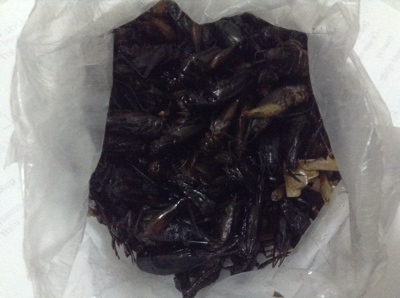
Snackalicious, but with a slightly off-putting appearance.
A bag of crickets qualifies fully as Friend Food. As in, they are best enjoyed in the company of a friend. We could have challenged each other to eat bigger and beefier specimens, and even the non-cricket bugs that made their way into the bag. As it was, I had only myself to compete against, and in the end I turned out to be feeble competition. It wasn’t even the taste. They tasted fine; a little crunchy, but not super crunchy, and oily, with a curiously hollow feel, like their insides weren’t there. There was really no difference between them and any other salty, seasoned, bite-sized snack morsel, except for the unavoidable fact that they had legs, eyeballs, and a body. It was a purely psychological block based on their appearance that kept me from eating more. Every time I reached into the bag to see if I could manage just one more, I didn’t want to do it. Had they been processed into some sort of nugget form, eating the whole bag would have been no problem. I had to admit defeat. There was no monkey available for a handoff, so they went into the trash. It got me wondering if I’ll be able to eat a tarantula if a tray of them cross my path. I want to believe that I could do it – I’ve heard they are tasty – but I’m not sure I can.
During my last week here in Cambodia, I came across krolan for the first time. It’s sticky rice (and a bean or two) that’s encased in bamboo, and is apparently a bit of a regional speciality in Kratie Province. Roadside vendors have them standing on end on their carts in bundles, and sell them by weight. They are the perfect travel food. I’ve only purchased one so far to sample, and ate it sitting outside my hotel, but they are dry (no leaking), sturdy (little or no crushing), and pack neatly into a day bag. It wasn’t the most exciting thing to eat, but was better than dealing with bruised apples and squashed oranges. Plus, the packaging is compostable.
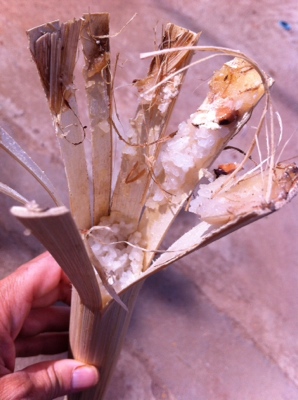
I used to obsess a bit over packing snacks for travel, thinking that I needed to prepare for long hours of hunger on the bus, boat, train. I’d spend time and money loading up on a variety of munchies, and then would hardly ever touch them. Sitting on transit doesn’t burn too much energy. I’ve learned that journeys under, say, eight hours, require very little. A bottle of water and one or two snacks is plenty. In most cases, food is readily available en route, and is frequently better than whatever I’ve packed, which is usually chosen based on how well it can survive being stuffed into a day bag. In the rare event that food isn’t available, I just put up with hunger pangs. They are minor, temporary discomforts, and make eating at the destination more of a treat.

 Cheese Skipping
Recent Comments